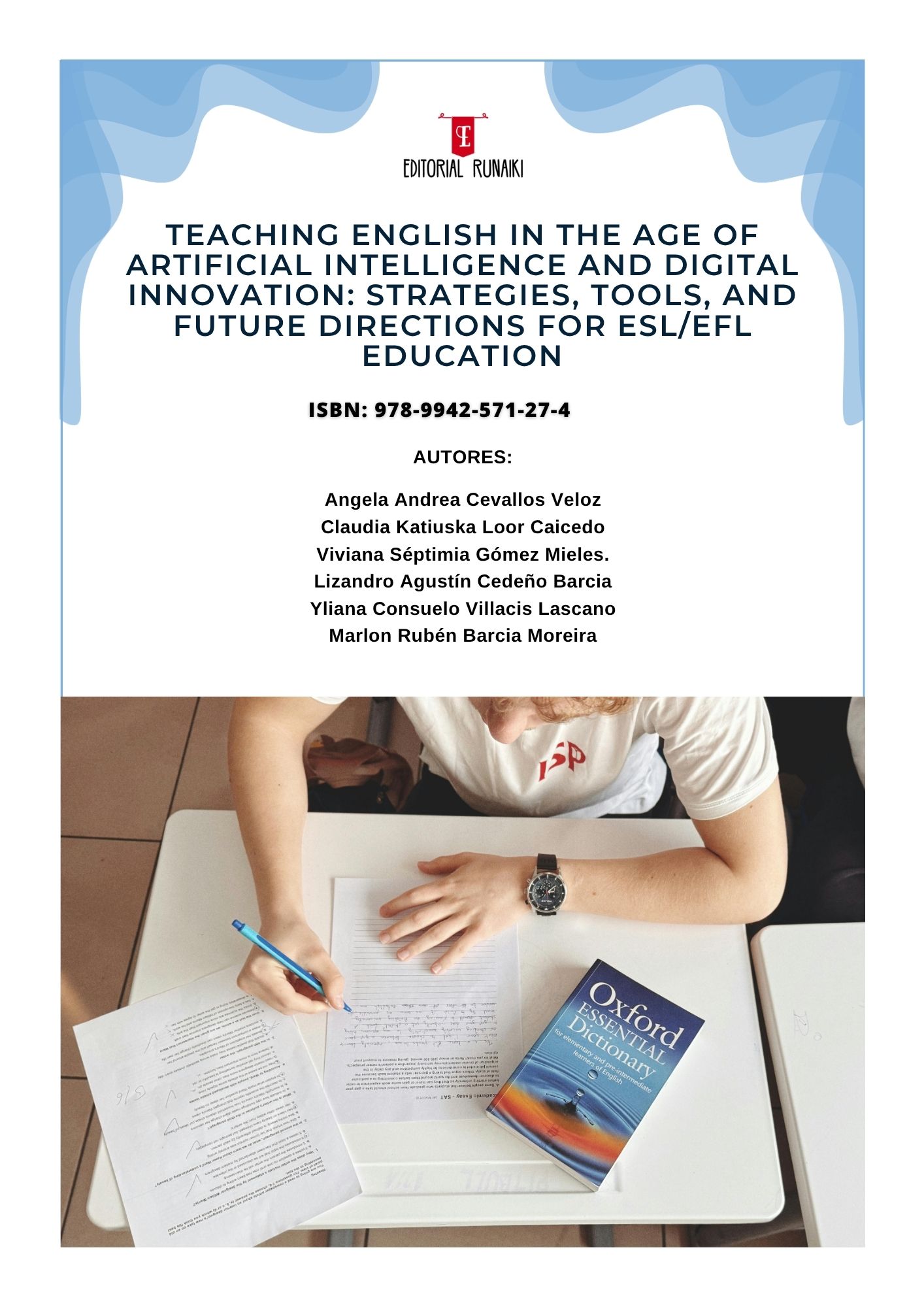
Teaching English in the age of artificial intelligence and digital innovation: strategies, tools, and future directions for ESL/EFL education
ISBN: 978-9942-571-27-4
Resumen
The teaching and learning of English are undergoing a profound transformation driven by artificial intelligence, digital communication, mobile technologies, and the growing availability of online educational resources. What was once considered an optional complement to classroom instruction has become an integral component of contemporary English as a Second Language and English as a Foreign Language education. Learning management systems, videoconferencing platforms, mobile applications, social networks, automated assessment systems, and generative artificial intelligence now influence how learners access information, interact with others, practice language skills, receive feedback, and create knowledge.
Descargas
Citas
Alemi, M., Salmani Givi, S., & Rezanejad, A. (2022). The role of digital storytelling in EFL students’ writing skill and motivation. Language Teaching Research Quarterly, 32, 16–35. doi:10.32038/ltrq.2022.32.02.
American Educational Research Association, American Psychological Association, & National Council on Measurement in Education. (2014). Standards for educational and psychological testing. American Educational Research Association.
Bachman, L. F., & Palmer, A. S. (2010). Language assessment in practice. Oxford University Press.
Barrot, J. S. (2018). Facebook as a learning environment for language teaching and learning: A critical analysis of the literature from 2010 to 2017. Journal of Computer Assisted Learning, 34(6), 863–875. doi:10.1111/jcal.12295.
Barrot, J. S. (2022). Social media as a language learning environment: A systematic review of the literature (2008–2019). Computer Assisted Language Learning, 35(9), 2534–2562. doi:10.1080/09588221.2021.1883673.
Barrot, J. S. (2023). Using social networking sites as a language teaching and learning environment. Language Teaching, 56(2), 181–196. doi:10.1017/S0261444822000167.
Black, P., & Wiliam, D. (2009). Developing the theory of formative assessment. Educational Assessment, Evaluation and Accountability, 21, 5–31. doi:10.1007/s11092-008-9068-5.
Brown, H. D., & Abeywickrama, P. (2019). Language assessment: Principles and classroom practices (3rd ed.). Pearson.
Publicado
Cómo citar
Número
Sección
Derechos de autor 2026 EDITORIAL INTERNACIONAL RUNAIKI

Esta obra está bajo una licencia internacional Creative Commons Atribución-NoComercial-CompartirIgual 4.0.